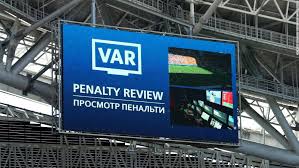
Video Assistant Referee (abbreviated as VAR) is a football assistant referee who reviews decisions made by the head referee with the use of video footage and a headset for communication.In 2018, VARs were written into the Laws of the Game by the International Football Association Board (IFAB) following trials in a number of major competitions.
Not focusing on its usage procedure, we’ll discuss about the technology used here and its advantages.
The VAR setup consist of a bank of monitor screens, multiple cameras covering all angles of the field and a board of Video Referees. The technology used here is not something extraordinary but it has brought a revolution in the game.

A call made to the VAR can be of 4 types:
- Possibility of an illegal goal
- Penalty Decisions
- Direct Red Card decisions
- Conversion of Yellow to Red card and vice-versa.
A critical decision made by the on-field referee can be overturned by the VAR according to the video footage evidence they get. The Video Referees are equally trained as the on-field ones. Hence, an appropriate decision is made according to the video footage evidences obtained.
Hence because of VAR, controversial decisions are avoided which maintains the dignity of the game.
The VAR is currently being used in major league tournaments and will also be introduced in the remaining leagues sooner or later.
But somehow, it has faced a hefty amount of criticism. The fans claim that VAR brings along a lot of time wasting. Also, it takes away the lucidity of the game by increasing the complexity. It has also made many controversial decisions which has caused some teams a defeat which they didn’t deserved.
Looking at the criticism and its positive side, it can be said that VAR is still in its growing state and can become a great example of TECHNOLOGY bringing changes to the normal procedures.





 TechPress